Designed for children between the ages of 4 and 6, the Mont 3 & 4 Programme recognises this stage as a crucial period of growth. With their naturally absorbent minds, children at this age are eager to explore and understand the world around them. Dr. Maria Montessori described this as the time to offer children the "keys to the world."
In response, we present them with meaningful experiences that introduce all aspects of their environment. The thoughtfully prepared classroom is a scientifically designed, age-appropriate space that supports the child's physical, emotional, social, and intellectual development.
Each classroom is carefully designed in alignment with Dr. Maria Montessori's principles. Through her lifelong scientific study of child development, she created a method that encourages children to grow towards independence - both physically and intellectually. The environment inspires curiosity, purposeful work, and self-discipline, allowing each child to develop at their own pace.
Our educators are deeply trained in child development, including physiology, psychology, and cognitive growth. They are qualified under the Association Montessori Internationale (AMI), Netherlands. With warmth and respect, the adults in the classroom guide children to make independent choices, develop self-reliance, and grow into socially responsible individuals, all while staying true to Montessori philosophy

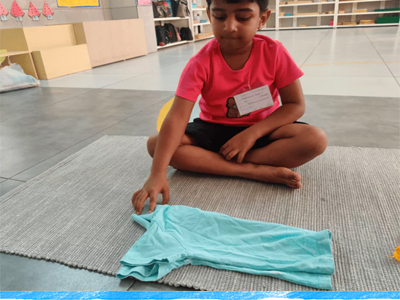
Practical Life activities are a distinctive feature of Montessori education. These exercises help children develop independence, coordination, concentration, and a sense of order. Activities such as graceful movement, care of the environment, and silence games support emotional regulation, focus, and social awareness.
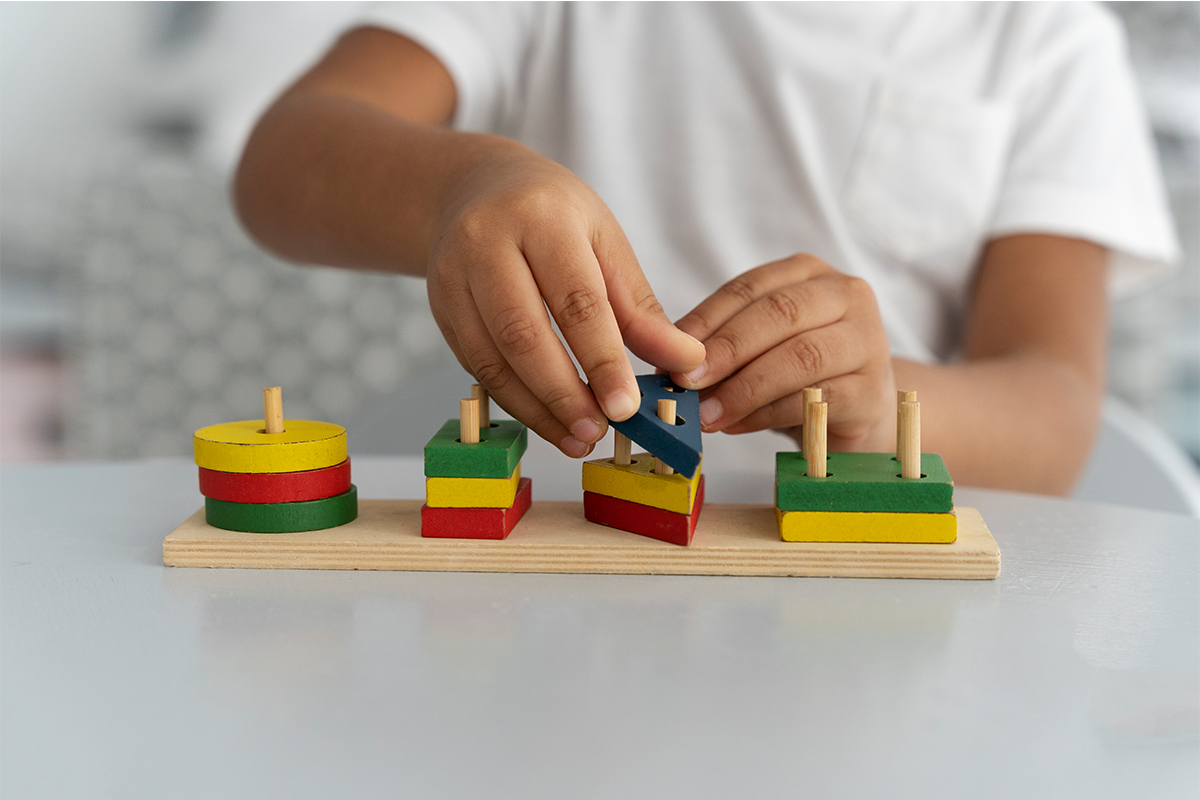
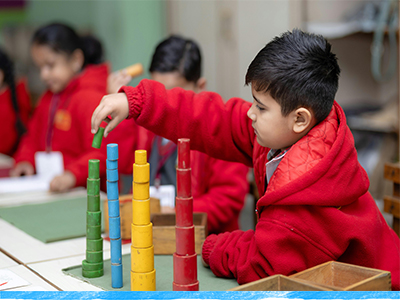
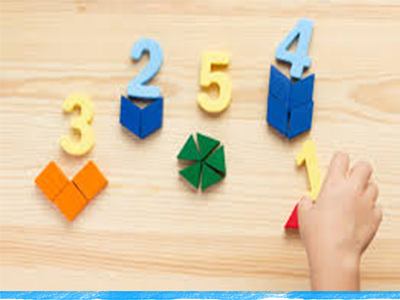
Children in the Primary years learn best through their senses. Sensorial materials refine perception and sharpen the ability to observe, compare, and discriminate. By engaging all the senses, children strengthen their intelligence and imagination, grounded in reality. This area also lays the foundation for concepts in Algebra, Geometry, Geography, and Botany.
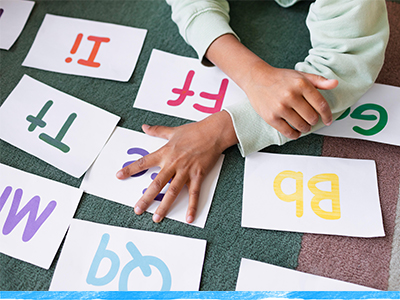
Language development is woven into daily classroom life through conversation, storytelling, and vocabulary enrichment. Phonics introduces children to letter sounds, enabling them to mentally form words even before writing. Gradually, children progress to writing, reading, grammar, sentence structure, and reading comprehension.
Cultural learning introduces children to the wider world and humanity as a whole. Through art, craft, geography, flags, and studies of different countries and people, children gain global awareness. Science experiments, plant care, and nature studies help them understand and respect the living world around them.